


Continuing my series exploring the history of German music of the 1960s-1980s and the often overlooked influence it had on British artists, we turn now to one of the most trail-blazing and significant bands in modern musical history. A group whose influence was vast and endures to this day, even though most in Britain have probably never heard of them – Can.
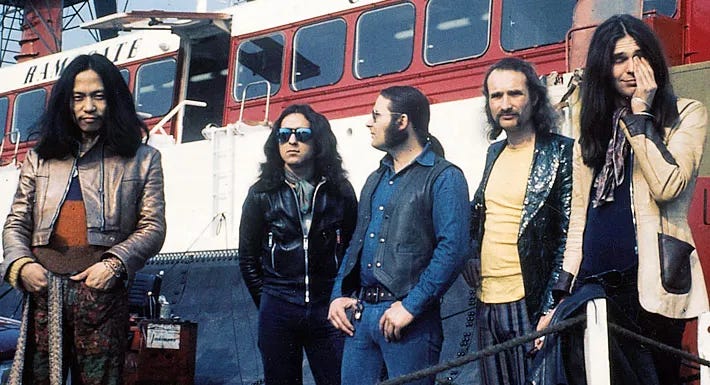
If I could choose one band before my time to have seen live, in their prime, it would be Can. A band so experimental they defy labels; they’ve come to define what many people think of as ‘krautrock’ yet never comfortably fitted into that already vague genre. Their sound often transcends the time and place in which it was created to feel truly borderless and universal in a way few contemporaries managed to achieve.
And yet, despite the universality of their sound, Can also embody a German musical tradition that treats music as something fundamental to the human experience. They could not have emerged from anywhere else.
The likes of Ash Ra Tempel, Popul Vuh and Amon Düül II - discussed in a previous post – looked to transcend the world in which they lived by looking outwards towards the cosmos. Can looked inwards, into the human psyche of the post-war Germany in which they grew up. As founding member Irmin Schmidt once said ‘as musicians we reflected the strangeness, brutality and harshness of what our parents’ generation did’.
Though respected in their native Germany, it was in France—and above all in Britain—that Can found true success and devotion. Their connections with, collaborations with, and influence on British musicians ran deep—arguably more than any other German artist of the era. That influence is the focus of this post.
But let us first go back to the start. 1968. The year of student revolution and shifting mindsets across Europe. A time when so many German musical pioneers were experimenting with new sounds and philosophies as we’ve discussed.
Irmin Schmidt and Holger Czukay were both classically trained musicians who studied under the revolutionary, internationally renowned composer Karlheinz Stockhausen (1928–2007). His influence shaped countless German artists, and his willingness to collaborate across genres blurred the lines between classical and popular music in a way rarely seen elsewhere.
Wishing to form a group, Schmidt and Czukay recruited jazz drummer Jaki Liebezeit and a young guitarist named Michael Karoli and began recording in Schloss Nörvenich – a 14th century castle outside Cologne.
Deciding they needed a singer, they almost by chance found Malcolm Mooney, a young African American in Europe seeking to avoid the Vietnam draft. His vocals were often trance-like and chaotic, infused with the beatnik spoken-word energy of his native New York.
When he left the band in 1969, struggling with addiction and mental health issues, Mooney was replaced by a Japanese busker they discovered in Munich, Damo Suzuki. Suzuki’s singing was improvised and often incomprehensible.
Both vocalists added an international dimension to the band and reinforced the idea of the singer as another instrument within the collective sound, rather than a traditional frontman.
I could go on at length about their albums and the experimental sounds and techniques they pioneered—early sampling, tape collage, and the fusion of blues, jazz, rock, and world music—but here I’ll focus on their influence in Britain.
When their first album – Monster Movie - was released in 1969, the British music press quickly took note.
Richard Williams, musical journalist writing in Melody Maker saw the Velvet Underground’s obvious influence on Can but also noted that they “have a lot of themselves to offer, mainly in the field of electronics, which they use with sparing brilliance.” Describing closing track ‘Yoo Doo Right’ (probably my favourite Can track if I was forced to choose) as ‘extremely startling’, particularly praising Mooney’s ‘wailing and screaming’ as ‘fitting perfectly’ in a way few others could.
Melody Maker also reviewed their second album - Tago Mago – in 1970 with similar awe, describing its sound as having an almost ‘alien quality’ contrasting it favourably with state of the British music scene with prog rock behemoths like Pink Floyd starting to feel bloated and dated.
Then there was John Peel – the arbiter of British (and German) musical taste. The influential British DJ was an early champion of the band, helping expose their music to British listeners on this shows and even inviting them onto his famous Peel Sessions, of which they did many in the 1970s.
He continued to play their music long after the group went their separate ways, ensuring they retained a cultic following in the UK.
Can first started touring Britain in 1972, but which time they had already gained a captive audience, frequently selling out the student venues where they played.
It was around this time the members of group became acquainted with Roxy Music. One of the more experimental avant garde rock groups of the time with links to the art world and probably most comparable to the German music scenes. Roxy had already toured with Amon Duul II in support.
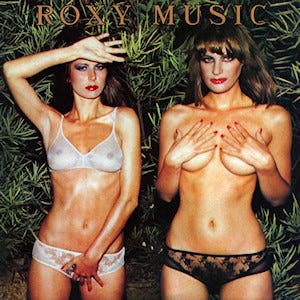
Hildegard Schmidt – Irmin’s wife and Can’s manager – allegedly applied Brian Eno’s elaborate make-up ahead of Roxy’s gigs when they were in the UK. Roxy Music’s 1974 album Country Life features two scantily clad model on the cover sleeve (as do most of their albums!) These were Constanze Karoli and Eveline Grunwald, sister and partner of Can guitarist Michael Karoli.
Can would go on to record a series of breath-taking albums over the next few years, though, as the band themselves admit, these declined towards their later output. Though they never formally spilt, they largely stopped working together after their 1978 album Out of Reach, their least interesting work. They briefly reformed in 1989 to record Rite Time, reuniting with Mooney, but didn’t tour.
By the standards of many contemporary bands, especially Kraftwerk (which I will write about) Can enjoyed limited commercial success. Given the way many refer to them in such abstract terms, my pretentious self included, they can sometimes feel like a group people claim to like to show off their musical credentials.
Can biographer Rob Young quips ‘you could argue that Can were a group of cognoscenti making music for other cognoscenti…but that doesn’t quite pan out’. It ignores their huge popular following at the time and ability to fill huge venues during their UK tours throughout the 1970s.
Their success has only grown since. The band were quoted as major influences by Joy Division, Buzzcocks, Talking Heads, Happy Mondays, and The Fall (another of my favourite bands I would have loved to see live).
Fall front man Mark E. Smith offered himself as a new singer for the band in the late 70s which never sadly happened. They recorded a tribute to the band with track “I am Damo Suzuki”, employing Leibezeit’s 4/4 pulsing ‘motorik’ drum rhythm on the track with more than a nod to Can’s “Oh Yeah”.
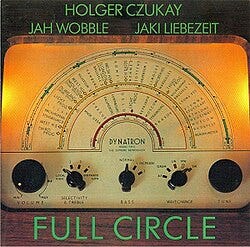
The Sex Pistols John Lydon (aka Johnny Rotten) also offered his services as a singer after Suzuki departed. Lydon’s sophisticated and developed musical tastes and credentials are often overlooked due to the silliness of his time with the Sex Pistols but his follow up (and far more mature, interesting and enduring outfit) Public Image Limited were also indebted to Can. Bassist Jah Wobble went on to record a series of albums and tracks with Jacki Leibezeit and Holgar Czukay in the late 70s and 80s.
Yet arguably Can’s greatest champion in the UK—and one of the key advocates for German experimental music more broadly—was Brian Eno. He would later move to Germany, drawn by what he saw as a more fertile environment for creativity.
And then, of course, there was another admirer: an arbiter and bellwether of British musical taste, someone who would also feel compelled to head to Germany in search of artistic renewal — David Bowie.
Subjects for my next post in the series.