

Reason of State
Has Germany's unwavering support for Israel finally reached its limit?

On Friday last week German Chancellor Friedrich Merz announced the government’s decision to suspend German arms sales to Israel, citing growing humanitarian concerns in Gaza and in direct response to Israel’s recent announcement of plans to take over Gaza City.
Such a decision may not seem particularly controversial to many British or international readers. Germany’s decision follows in the footsteps of many other nations which have suspended or cuts arms sales to Israel since the invasion of Gaza, including Canada, Spain, Belgium, Italy, Slovenia, and the Netherlands (though not, it should be noted, the UK and France, who have still not made such a move despite much public criticism of Israeli actions).
However, as with most matters, history weighs more heavily on German decisions, and the move has sparked much debate and no little controversy in the country.
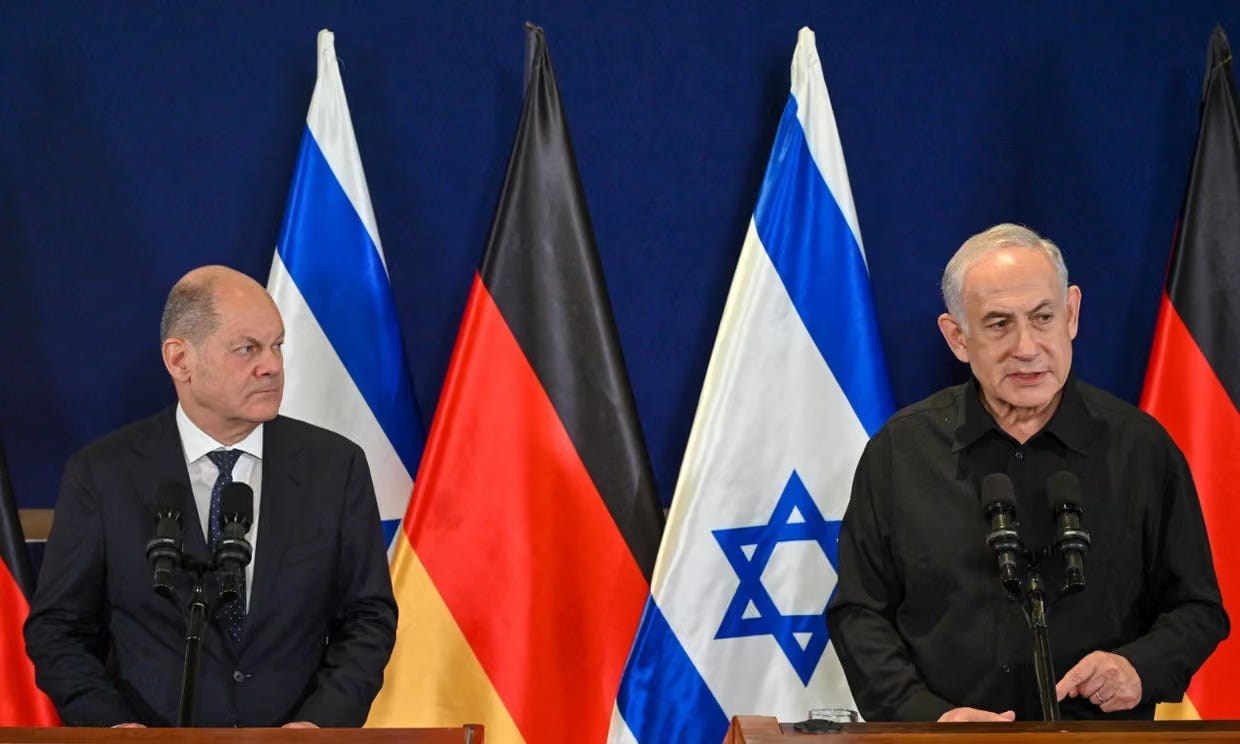
Chancellor Olaf Sholz with Israeli PM Benjamin Netanyahu, October 2023. Photo: Getty Images
The response among politicians in Merz’s own conservative CDU party has been mixed, though less frosty than they would have been just a few years ago. CDU majority leader in the Bundestag, Jens Spahn, called Merz’s decision ‘justifiable’ whilst quickly reiterating that the CDU remain a ‘firm friend of Israel’. Others in the party were more critical. Boris Rhein, CDU Minister President for the federal state of Hesse, felt the sale of arms should continue and announced on Twitter that the Hesse CDU ‘stands unconditionally by Israel’s side’ [my italics] in line with the CDU’s previous, steadfast, Israeli support.
Social Democrats and Green MPs largely supported the suspension, citing human rights concerns and the need for Germany to take a principled stance on the conflict. It was the far-right Alternative for Germany (AfD), who were most critical, accusing the government of ‘abandoning a key ally.’
Splits in opinion can also be seen in Germany’s major newspapers and media outlets. The Süddeutsche Zeitung, a centre-left broadsheet, was quietly supportive, calling the arms suspension “a turning point in German foreign policy - one which must be guided by both moral clarity and sober realism.” While Die Welt, a respectable centre-right peer, warned that “Germany risks isolating itself from its most important partner in the Middle East, with unpredictable consequences for European stability.”
Such responses highlighting the significance of the decision is understandable given the country’s history. Something which is worth digging into.
Support for the state of Israel was quick to be an important part of West German policy after the country’s foundation in 1949. Whilst early support throughout the 1950s was more muted than it would later become, there was much economic support. In 1952 West Germany’s first post-war chancellor, the CDU’s Konrad Adenauer, signed the Luxembourg Agreement in which West Germany agreed to pay reparations for their country’s treatment of Jews under the Nazis. These amounted to 3 billion DM to the state of Israel, and a further 450 million DM to Jewish organizations.
West Germany was surprisingly late to formally recognise, and create diplomatic ties with, the state of Israel. Whilst part of this was driven by a desire not to be seen as making token gestures, it was largely strategic: Bonn knew that formally recognising Israel would lead most Arab states to cut ties with West Germany and formally recognise East Germany, something that was anathema to the Adenauer regime throughout the 50s.
The tide was turning by the 1960s though. When the SPD’s Willi Brandt became Chancellor, Bonn became more willing to normalise relations with the GDR. This made establishing formal diplomatic ties with Israel easier by 1965.
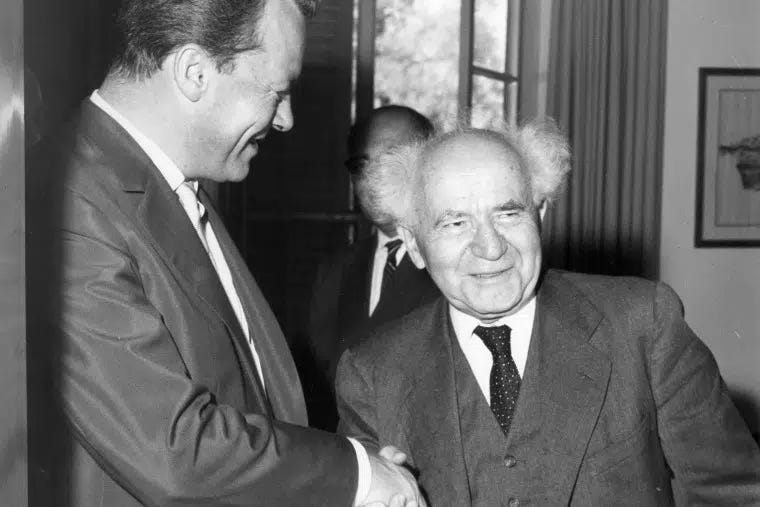
Chancellor Willi Brandt with Israeli PM David Ben-Gurion, 1960. Photo: Willi Brandy Archiv
Support for Israel grew among the public after the 1972 terrorist attack at the Munich Olympics, in which Palestinian terrorists killed 11 Israeli athletes in the Olympic village. Such support increasingly became a one-sided special relationship and ever more unwavering from then on.

Attack on Israeli athletes at the Munich Olympics in 1972. Photo: CSU Archive
But of course, this wasn’t the whole picture. The eastern German Democratic Republic (GDR) had a very different stance towards Israel. While the western Federal Republic agreed to pay reparations to Israel as penance for the Nazi war crimes, the East German state refused to acknowledge any responsibility; claiming, ludicrously, that all fascists had been removed from their socialist utopia. Instead they went as far as supplying political, economic and military support to Israel’s Arab neighbours, including the Palestinian Liberation Organisation (PLO).
This aligned, naturally, with the official Soviet anti-Zionist stance after the 1967 Six Day War in which Israel launched pre-emptive strikes against its Arab neighbours, massively increasing its territory. The GDR voted against Israel in most UN forums from then on, and hosted PLO representatives in East Berlin.
Even the aforementioned terror attacks in 1972 shows the level of east German support for and involvement with Palestinian groups: one of the terrorists’ demands was the release of Andreas Baader and Ulrike Meinhof, German left-wing militants held in a West German high-security prison after a string of domestic terror attacks.
I detail all this to emphasise the fact that it’s somewhat misleading to talk about a single German policy or attitude towards Israel after WWII.
After reunification East German attitudes towards Palestine (along with virtually all aspects of East German life, culture, or policy, good or bad), were not considered as the state was fully subsumed by West Germany. This is a topic about which I have written much. In this context it meant the German support for Israel since the 1990s has been more unwavering than ever, at least officially. Dissent from that stance, unacceptable.
This unquestioning support was effectively confirmed by Angela Merkel in 2008 when she delivered a speech in the Knesset (the Israeli parliament). Acknowledging German responsibility for the Holocaust, she declared that ‘Israel’s security is and will remain part of Germany’s Staatsräson.” The very reason for the state of Germany to exist today. Using such a term, Merkel elevated Israel’s security to a non-negotiable, core principle of German foreign policy, meaning Germany would stand by Israel’s right to exist and defend itself as a matter of national identity, no matter what!
One of the many statements and actions made by Merkel which have proved restrictive and problematic for her successors and the country itself.
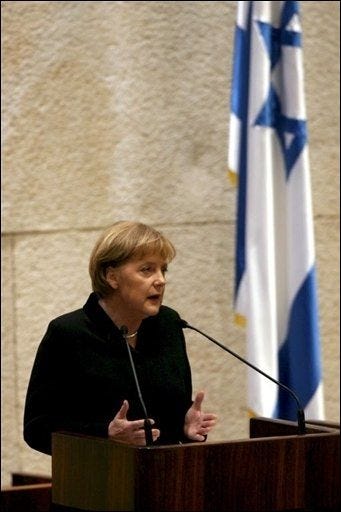
Chancellor Merkel delivering her ‘Staatsräson’ speech at the Knesset, 2008. Photo: AFP
However, attitudes towards Israel have been changing in Germany since then. Aside from former east Germans whose historic allegiance was always towards Palestine, the number of immigrants from Islamic countries, who also tend to have more sympathy for Palestine, has grown significantly since 2008.
A recent poll by the Allensbach Research Institute for the Frankfurter Allgemeine Zeitung, a leading centre-right national paper, suggested 57% of Germans now hold negative views of Israel, an unimaginable leap from the 23% when a similar poll was held just 3 years earlier. Though not broken down explicitly by age, other reporting confirms that younger Germans are increasingly critical of and less influenced by Holocaust-era obligations.
Internationally, Germany’s decision has naturally drawn much attention, far more so than any of the other countries mentioned earlier. Israel’s government responded with disappointment and urged Berlin to reconsider, citing the importance of defence ties in the face of regional threats. European allies expressed understanding of Germany’s dilemma, but some privately worried about the precedent it might set for future arms trade decisions in the EU. The US State Department released a statement reiterating the need for close consultation among allies.
Arab governments, meanwhile, welcomed the move as a positive development, with Egypt and Jordan publicly praising Germany’s “responsible stance.”
Germany has deep historic ties to Israel and a unique sense of guilt and responsibility to the country’s people. If they can be bold enough to suspend arms sales in light of what’s happening, will British leaders take note and finally be brave enough to make a similar decision?
I learn so much from your posts.
This was a splendid read that provided me with lots of important context for the importance of this decision. I enjoy your posts and find them a pleasure to read.