

Same Procedure As Last Year?
A peculiar German tradition most Brits will never have heard about

As today is New Year’s Eve, it seemed fitting to look at some of the favoured activities undertaken in Germany to mark the occasion, with a focus on one tradition which those outside of Germany may find very amusing and endearing.
I first moved to Germany after finishing my postgraduate degree to teach English in a school. As the Christmas holidays approached in the that first term, I naturally asked the other teachers and pupils what they were doing for Christmas and New Year’s Eve.
As they described some of their New Year’s Eve traditions, one of the first things I realised was how few we have in Britain, or much of the English-speaking world.
We raise a toast and watch elaborate fireworks from central London (usually on TV). There’s also the tradition of listening to the chimes of Big Ben at midnight (again, on TV for the sensible majority who don’t trek into London that evening) as we link arms and sing of Auld Lang Syne (itself of Scottish origins where New Year’s Eve, or Hogmanay, is taken more seriously than the rest of the UK).
Beyond that there are few customs beyond paying through the nose to get into an overcrowded bar or club, having a fairly awful time in said establishment, attempting and usually failing to kiss someone at midnight, and falling asleep on the all-night public transport on the way. At least these were largely my youthful New Year’s Eve experiences.
I was struck by how New Year's Eve is considered more of a family event in Germany, as it in many countries. Something that appeals far more to me these days than trying to have a good time pubbing or clubbing.
The occasion is known as Silvester in the German-speaking world, as it is in much of central and eastern Europe (Szilveszter in Hungary, Sylwester in Poland).
This is something I did not know before moving to Germany and thus did not understand what the children meant when they kept referring to their plans for ‘Silvester’. Was Stallone venerated in Germany at this time of year for some reason? Did he deliver toys instead of Santa?
For non-German readers or those not well versed in their hagiography, St Silvester was a 4th century Pope whose saint’s day falls on 31st December (in the western Gregorian calendar). He was the chap who allegedly converted the Roman Emperor Constantine the Great to Christianity after curing him of leprosy, thus changing the course of the Roman Empire and western history.
Not a bad resumé for someone most of us have never heard of.
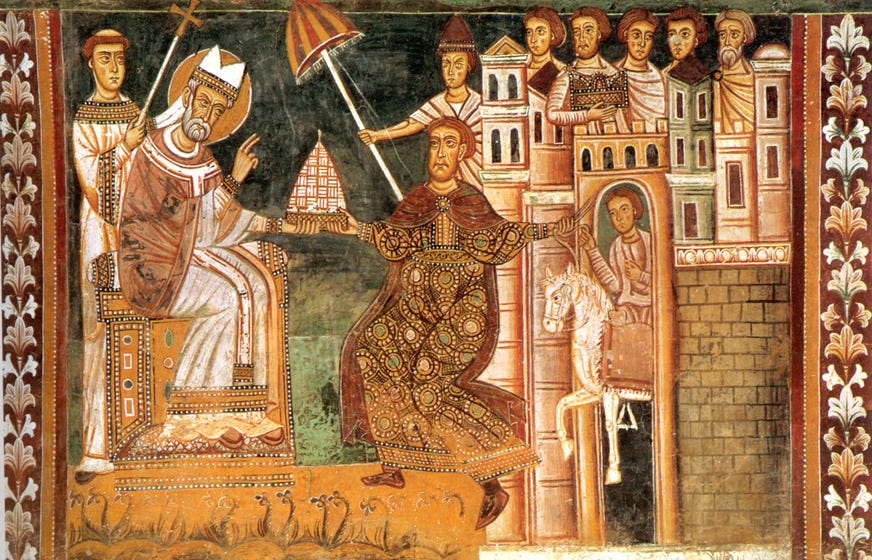
Silvester and Constantine
After learning the etymology of the occasion and the history of St Silvester, I was keen to learn more about the traditions Germans practice on the final evening of the year.
There are obviously similarities to what we have in Britain – fireworks are not uncommon, a glass or two of bubbly is consumed and lots of food and drink is shared. There are also some unique and charming little customs like exchanging Glückpilze or ‘lucky mushrooms’ (mercifully in marzipan form). The Chancellor delivers a TV message, and younger people take part in Bleigiessen (literally ‘lead pouring’) where little lumps of metal (thankfully no longer actual lead) are melted and poured into water, the shapes revealing what the year ahead has in store for you.
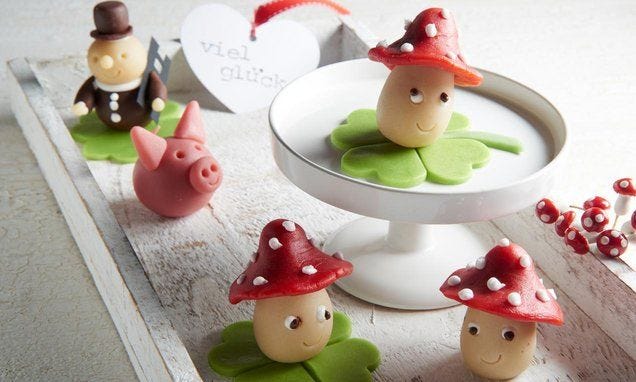
Lucky marzipan mushrooms
Some of the kids rather sweetly brought a set into one of my study groups after school one day before Christmas. I forget what my future held, but as we sat there melting metal over an open flame in a school classroom, I was struck at how much of a myth it is that Britain’s excessive health and safety regulations were driven by European Union regulations. I certainly haven’t noticed a rise in children playing with molten metal since Brexit.
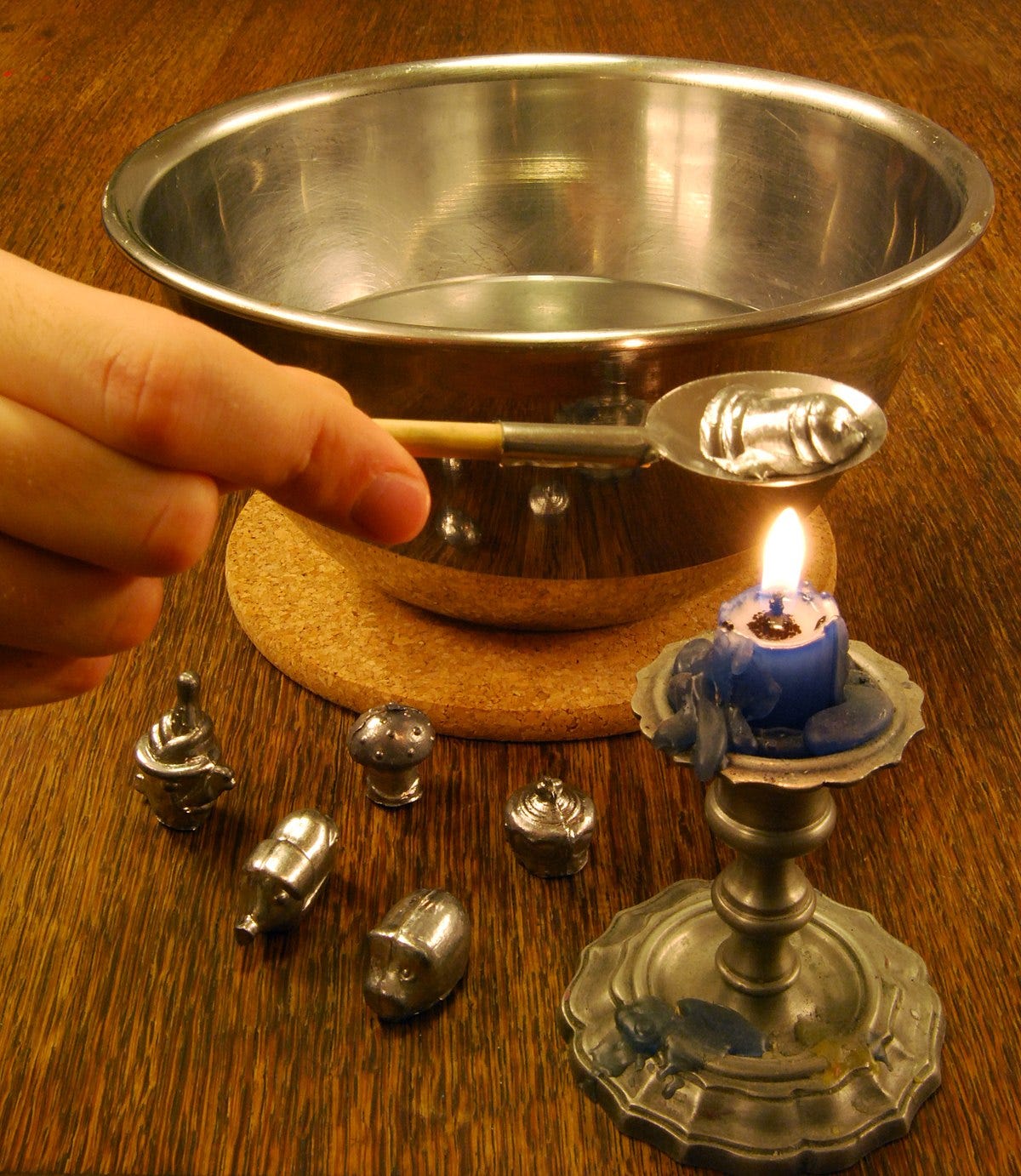
Lead pouring - what will your future hold?
But I digress. There is tradition which I found most fascinating and that is the near compulsory, universal viewing of a bizarre, obscure, British comedy sketch called Dinner for One.
The 18-minute film, performed entirely in English, by two English actors, first aired on German TV on New Year’s Eve in 1963. May Warden, who hailed from Yorkshire, plays Miss Sophie, a wealthy, aristocratic, (and seemingly senile) old lady celebrating her 90th birthday, while Grimsby-born Freddie Frinton plays her butler, James.
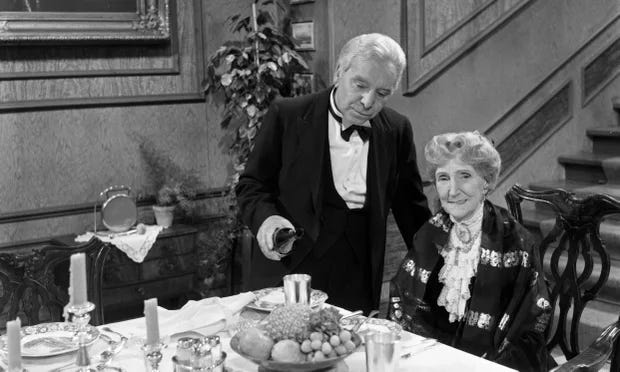
She has invited all the usual guests to her party, but, and herein lies the joke, they have all long since passed away, so butler James must impersonate every guest, drinking their drinks as they each raise a toast to Miss Sophie, becoming more and more inebriated as the sketch progresses, repeatedly tripping over a tiger skin rug.
Throughout the procedure the two actors repeat the lines of ‘Same procedure as last year Miss Sophie?’, ‘Same procedure as every year James!’ At the end Miss Sophie retires to bed followed by James where the pair repeat the above lines, to which Frinton turns to the camera and cheekily says ‘I’ll do my very best!’
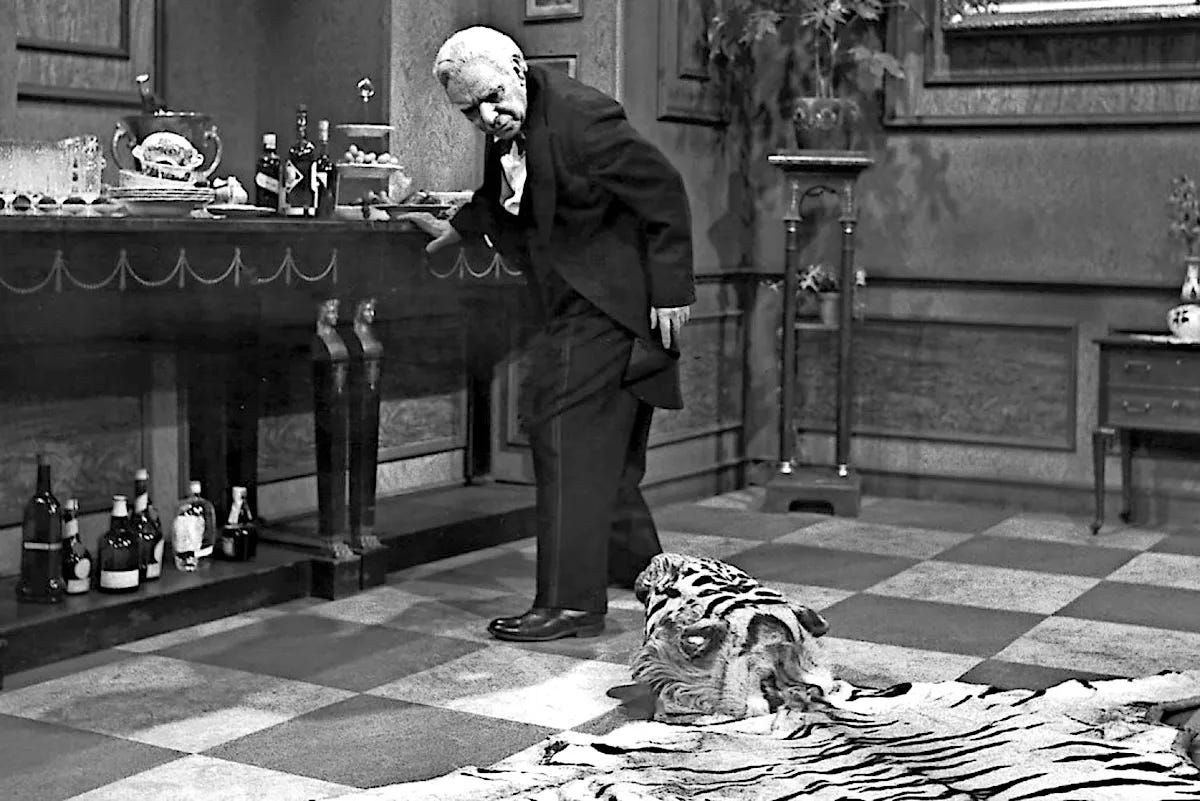
And that’s it! Germans always seem incredulous when Brits don’t know the sketch. Outside of fellow Brits who have lived in Germany, I’ve never met a British people who has heard of it. Yet in Germany (and other German speaking and Scandinavian countries) it’s a New Year’s Eve institution.
Eventually someone brought in a DVD copy to school and made me watch it. I sat through the sketch chuckling mildly, mainly out of politeness.
It’s not unusual for people to repeatedly watch their favourite films, especially at Christmastime. Given the general German approach to most matters – finances, entertainment, cuisine – of favouring predictability and stability, it’s not hard to understand why the innocent, predictable, even if slightly dated, humour of Dinner for One found a captive audience when it was released in post-war Germany and quickly became a peculiar part of New Year’s Eve festivities.
However, it is the fact that the sketch is performed entirely in English with no subtitles I found most intriguing.
The sketch was based on an old routine performed at British music hall shows back in the 30s and 40s. However, as I subsequently discovered, the now famous film was produced entirely by Germans for the German broadcaster NDR in 1962, with no intention of it ever airing in Britain, which makes the fact it’s all in English even more intriguing.
Yet it is popular because of its very ‘Britishness’, not in spite of the fact and provides an interesting insight into how Germans see, or at least like to imagine, us Brits.
The short film portrays a world of fading aristocracy (a genre always popular with foreign audiences as the recent international success of shows like Downton Abbey testify). With its class-ridden, eccentric, quirky, somewhat risqué atmosphere, the sketch simply wouldn’t have worked in German or set in a German world. The 1960s especially were a time in which few German TV producers would have felt comfortable making a similarly affectionate sketch set among the earlier German aristocracy. This was the very time in which the West German nation was coming to terms with its recent past and accepting collective responsibility for its actions during the Second World War.
The aristocracy, particularly the dominant Prussian aristocracy, was still seen (unfairly in my opinion) as tainted with the militarism and extremism which led their nation into two catastrophic wars. Britain’s aristocratic past, or indeed present, allowed for a less problematic, vicarious form of nostalgia.
For anyone interested in viewing the sketch you can do so here
Germans also wish each other ‘einen guten Rutsch’ or a good slide into the new year. There is debate about whether this comes from the old Yiddish word for the new year ‘rosh Hashanah’, the German love of sleigh rides (see post on Prince Albert) or simply a comical expression.
At any rate, I’d like to wish all my subscribers and followers ein frohes neues Jahr und einen guten Rutsch ins 2025!
There are two ways for me to identify a fellow German abroad: They watch „Dinner for 1“ on New Year‘s Eve and „Tatort“ every other Sunday. No one else would find this funny or exciting.
Thanks for this piece, it took me right back to my childhood memories in Finland melting lead (eek) and divining future from the clump! Also you answered a question I was just briefly wondering about yesterday, looking at the calendar my mum sent me last Christmas. 31 Dec is the name day for Sylvester. It’s a very unusual name back home - now I know why it’s there!