

Un Point
Another year, another last place finish for the UK at Eurovision

Saturday night was the 70th annual Eurovision Song Contest. One of my favourite events of the year. Another year of the UK lurking at the bottom of the leaderboard, with Germany keeping us company. Though this year’s content was once again marred by more important controversies.
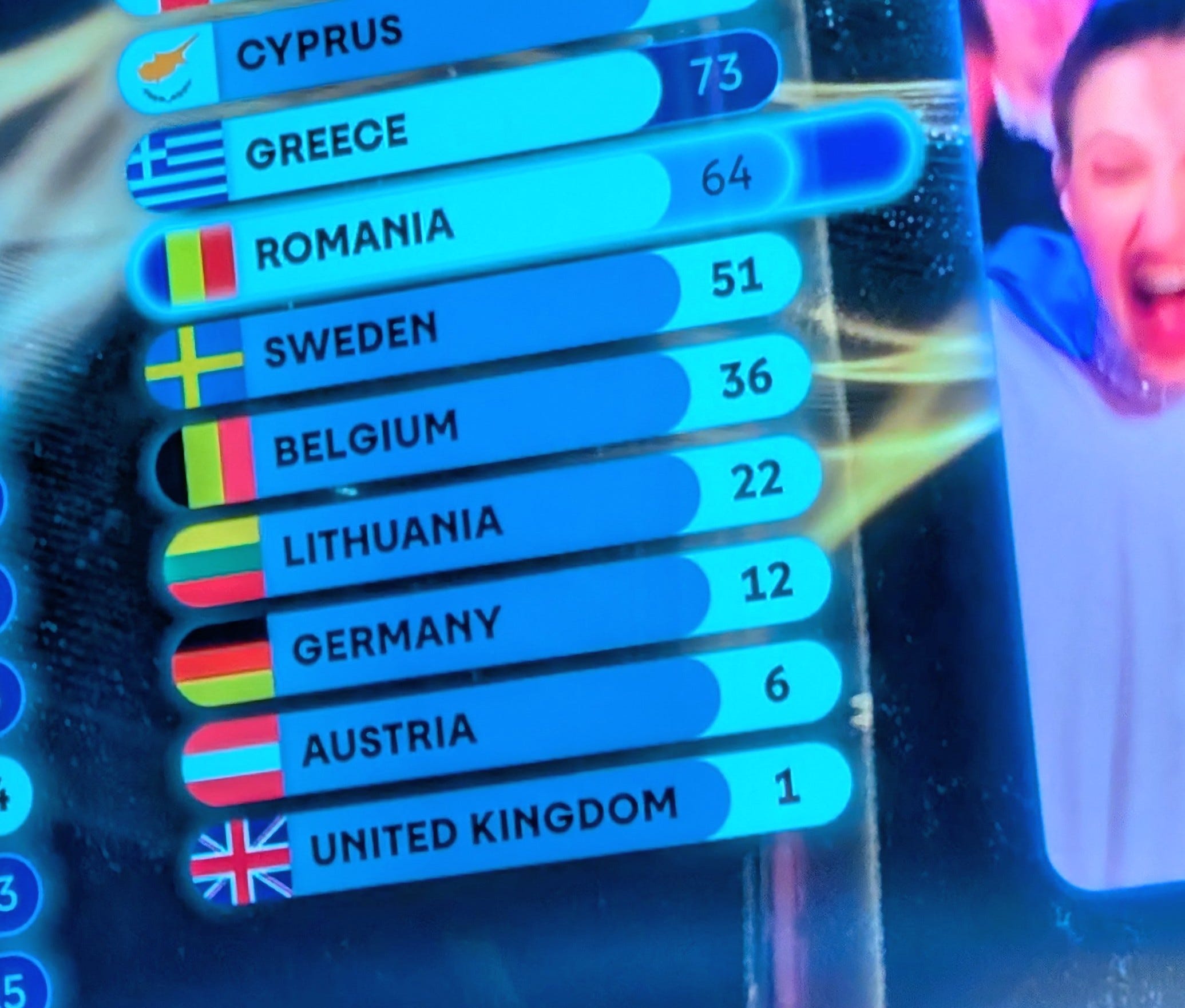
Saturday night’s final tally
For two nations with such strong musical heritage, about which I’ve written many posts, it’s somewhat surprising we also both do so badly. Especially Britain with its global dominance of pop music.
Then again, it’s hardly surprising. Eurovision has long been a popularity contest, and Britain and Germany, each for their own historical reasons, don’t usually rank among the world’s most popular.
Though the UK has won the contest an impressive 5 times, and Germany twice, in the competition’s 70-year history, both countries have also spent more time near the bottom of the table than almost anyone else.
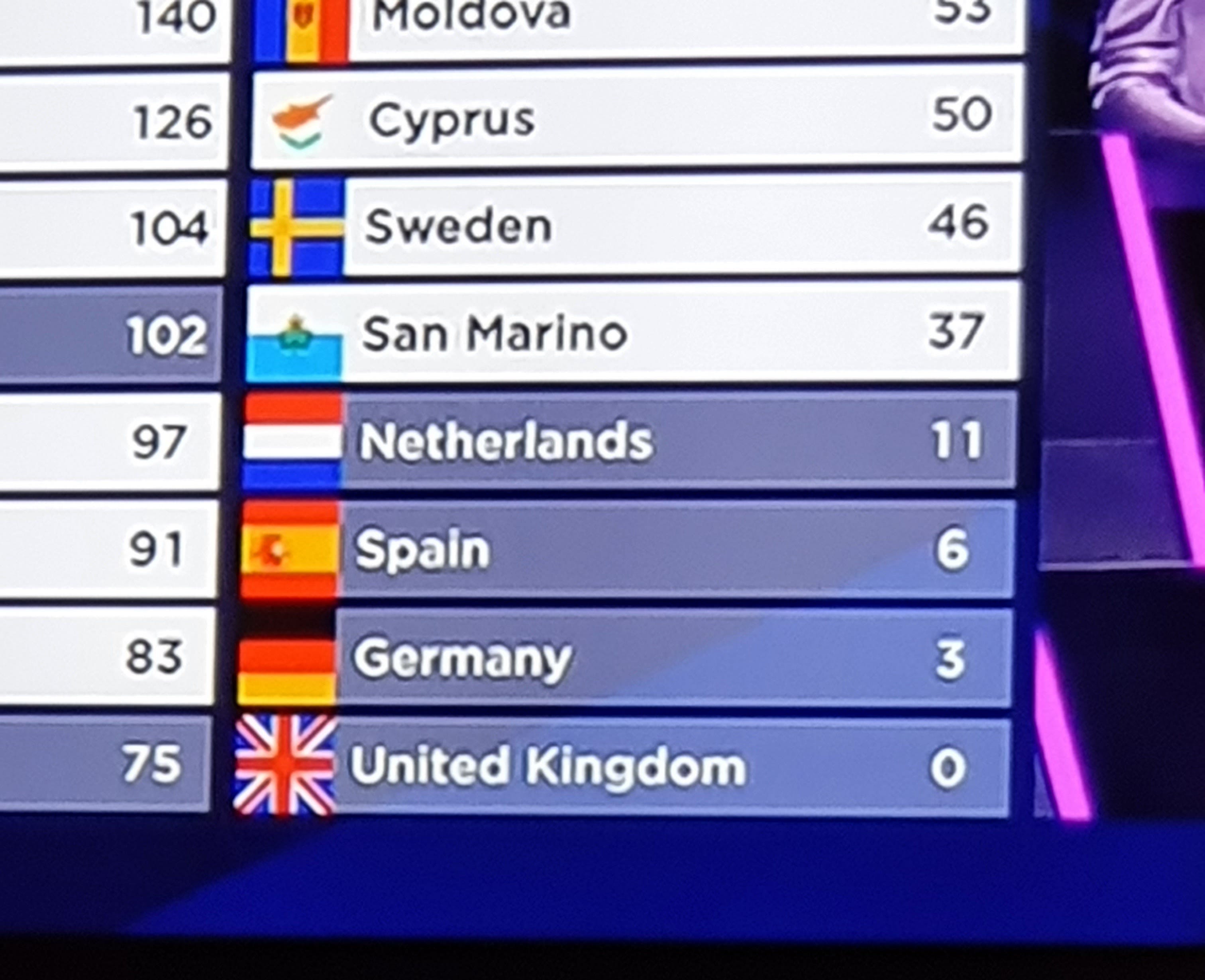
The results from a few years back
The UK’s choice seemed doubly destined to fail, by adding a German angle: Eins, Zwei, Drei is about a British worker quitting his office job so he can move to Germany and count to three (probably more to analyse in this but that’s another story!)
It’s not that either of countries’ choice of songs this year was especially bad. That’s not to say either was especially good. My seven year old seems to really enjoy our entry before falling asleep, however.
Yet quality of the song rarely seems to be the deciding factor in a country’s total points in a contest that is increasingly political - although Bulgaria’s winner was fantastic!
When the competition was decided exclusively by juries, it often felt unfair. Certain countries seemed almost guaranteed to award their 12 points to neighbouring or politically favoured states.
When the public vote was combined with the jury vote in 2009, it briefly seemed as though the contest might become a little fairer. Alas, that has not been the case.
Britain doing poorly in the competition is never something that has bothered me. I wouldn’t continue watching it if it did.
It’s the fact that one country always seems to do so well. Israel.
Leaving aside geographical considerations about the country’s inclusion (Australia are a frequent contestant after all) that the world foremost pariah state is still allowed to particpate, while Russia continues to be excluded (and rightly so), raises questions.
Given that anyone in the world can vote — and can do so multiple times — the voting system has also become a major public relations opportunity for Israel.
Israel has always seen the contest as a chance to exert soft power and position themselves as a normal peaceful, progressive ‘European’ state, whilst they commit questionable actions nearer home.
Yet the past few years have been especially shocking. Since the destruction of Gaza and ongoing horrors in Lebanon, it’s hard to think of a state more widely condemned by the international community than Israel. This year saw the largest boycott in the competition’s history with Spain, the Netherlands, Ireland, Iceland and Slovenia all refusing to participate due to Israel’s inclusion.
And yet at this year’s content, like the year before, Israel dominated the public vote - evidence that the system is anything but fair or representative. Democracy in microcosm, dressed up in camp festitvity.
I love Eurovision and couldn’t bring myself to boycott as most friends I know did. However, if the organizers don’t grow a spine and finally ban Israel from next year’s competition (which I highly doubt they will) then I may have to join the boycott. At least I won’t have to see the UK end up with nil ou une points as usual.
Maybe the UK should participate in the heat stage? It’s perhaps buying a seat in the final that is part of the issue. My favourite song was Luxembourg - they went out in the semi with four other countries. Also really liked Sweden’s entry. Less humiliating to test the water then.